Drawing exercise: describe objects with your fingers!
Describing the qualities of an object without naming it
This is an exercise we did to really ‘look’ at, or pay close attention to, the shape, texture, quality, material, sound and smell of objects. Ideally this exercise is done with at least two people. In this instance we were nine, so I show an example of a list, a drawing and two objects that I made as a result.
-
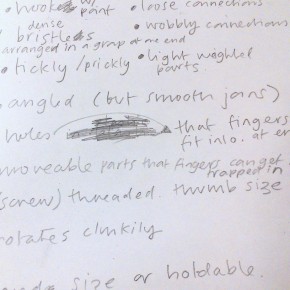
- My description was more of a list; there were multiple objects in the bag with contradictory qualities, ie shiny / bristly.
-
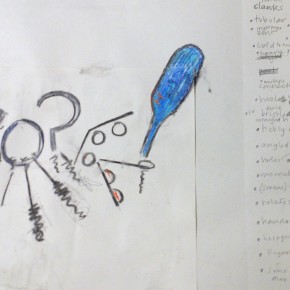
- I think that made it quite difficult for the next person to combine their qualities into a cohesive drawing. If I were to do it again, I’d definitely think about trying to organise it into a more connected description.
Random things are put into a black bin liner which is numbered. Put your hand into the bag, and using touch to inform you, write anything you can that describes what you feel. Even if you can guess what the object is, write down all the qualities of the object without naming it. Do this for about 15 minutes.
Making a drawing from the description
Swap your list with another person, and use the description or words you now have to make a drawing. Think about how you’d convey any of the qualities, ie weight, shape, material etc.
-
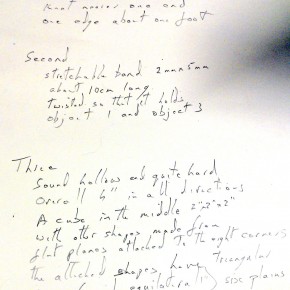
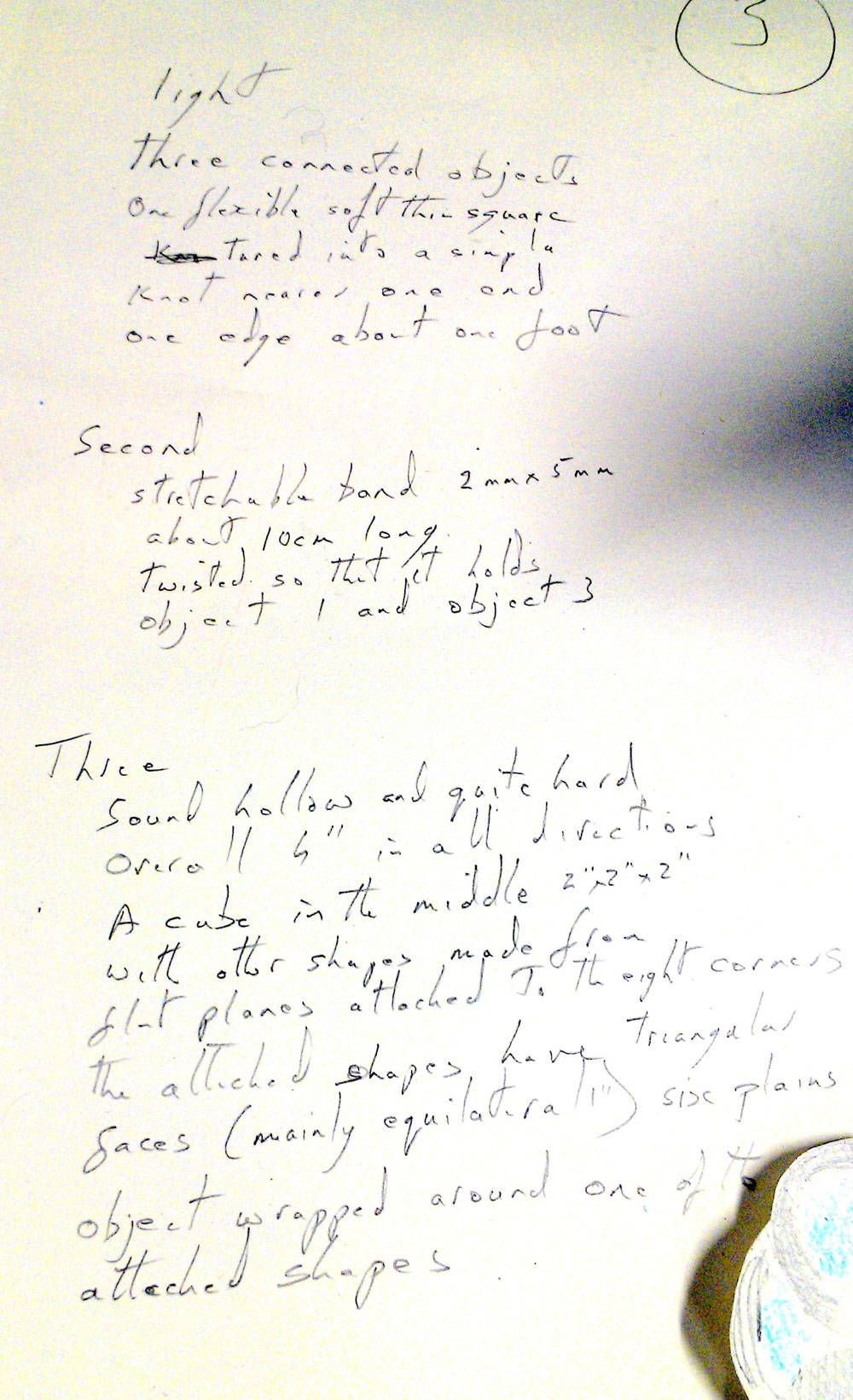
- Someone’s description of three objects in a bag
-
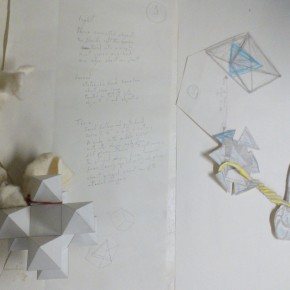
- One of the original objects from the bag; the description; and the drawing created from the description

-
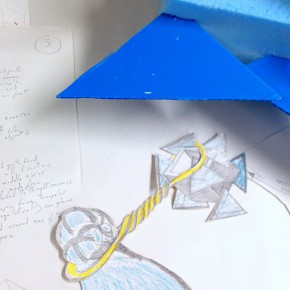
- The description of the objects in the bag; the drawing created from the writing; part of object created from the drawing

Making the drawing above, I misread part of the description, and understood the last part to be one sentence “six planed object wrapped around one of the attached shapes” and drew another geometric form (a triangular dipyramid, polyhedra fans…)

Below is one of the sculptural objects created from the drawing I was given (show above); as the drawing was purely linear, I gave myself free rein to create the ‘lines’ on a mixture of planes. I like this playing with dimensions and it’s something I’ve experimented with before.
-
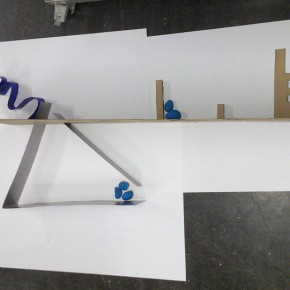
- Looking from above at the 3D drawing
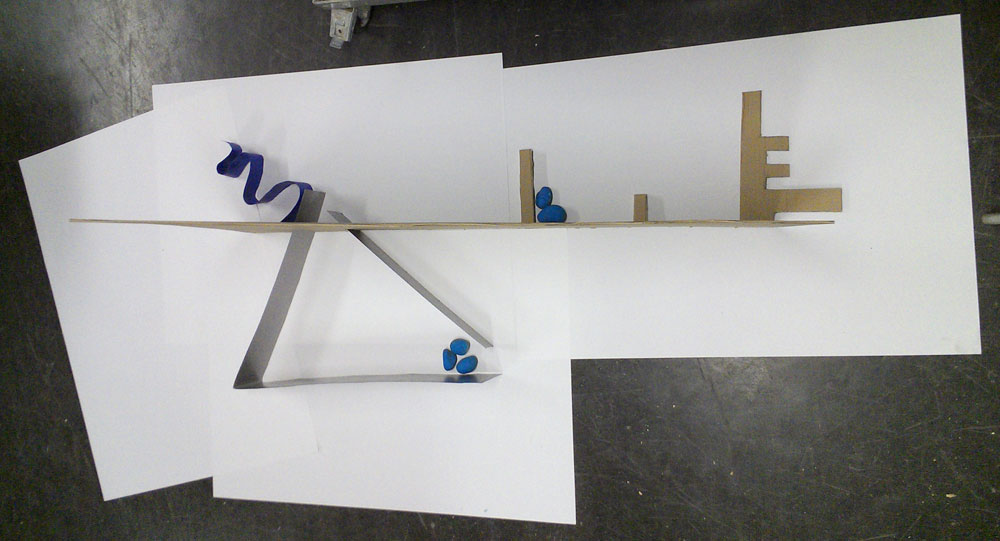
-
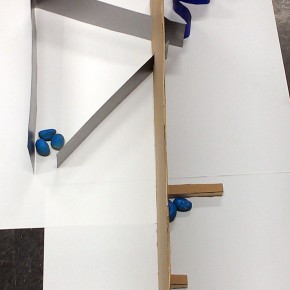
- Looking down on the 3D drawing

-
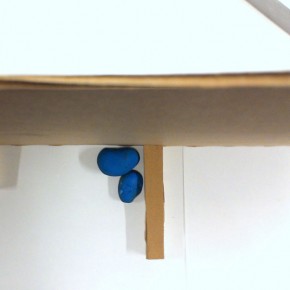
- detail of 3D drawing
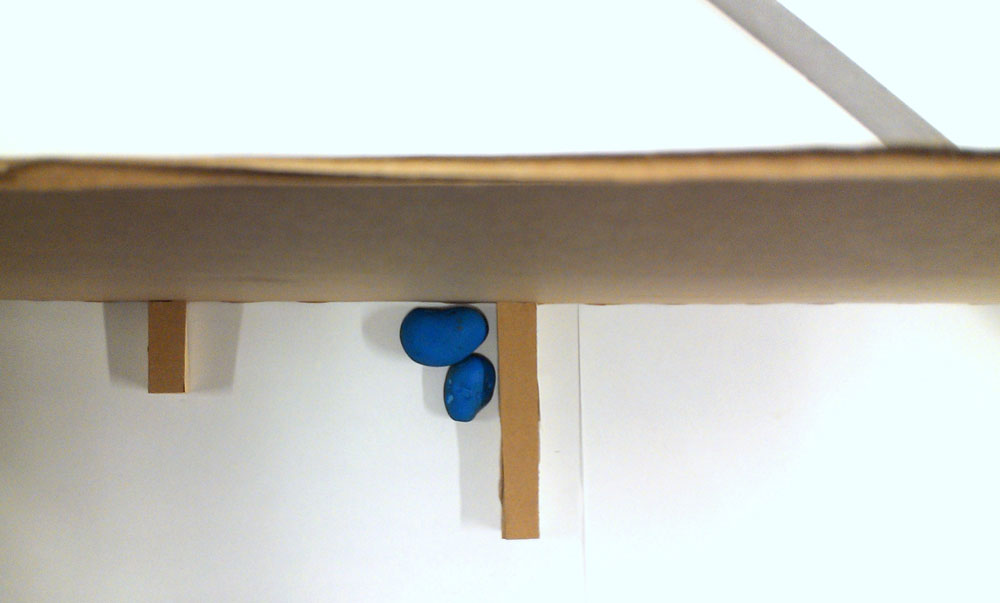
-
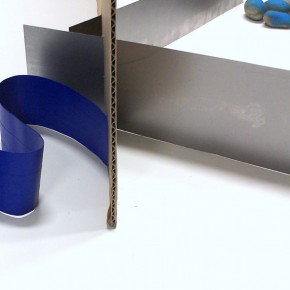
- detail of 3D drawing
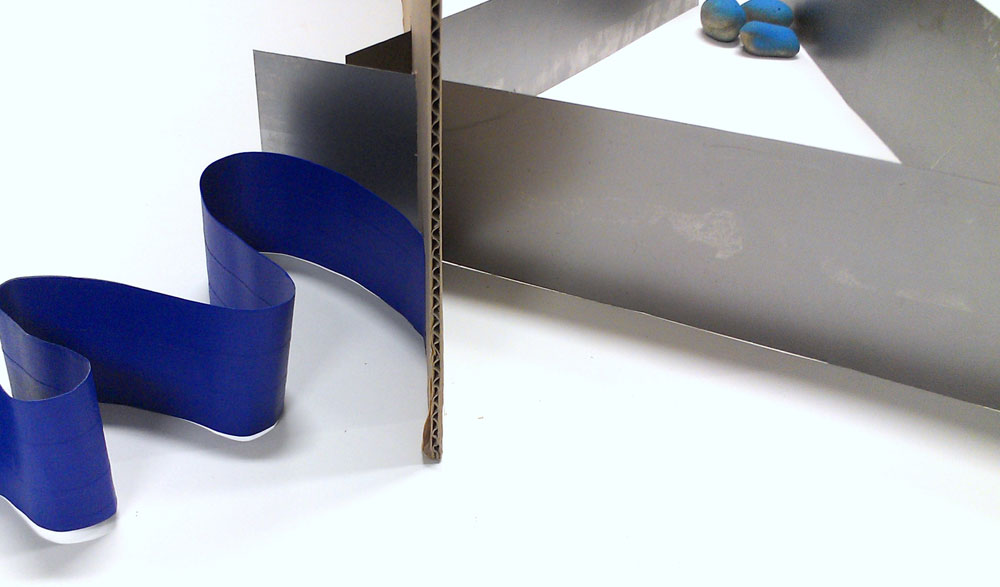
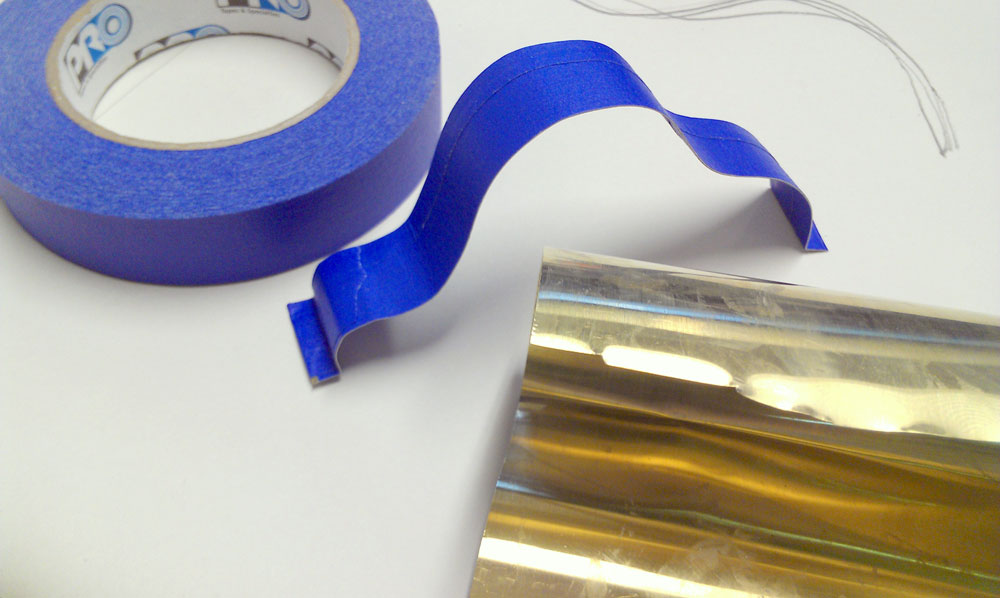
Another sculptural form created from part of the drawing. I extruded the lines to form platforms. I really liked the effect of covering brass shim in coloured masking tape (see below); I’d like to experiment with this use of materials again.
-
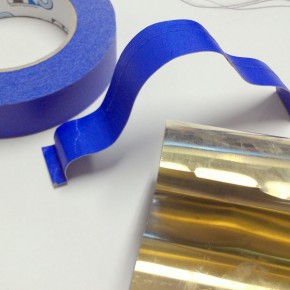
- New material made by covering brass shim in coloured masking tape
-
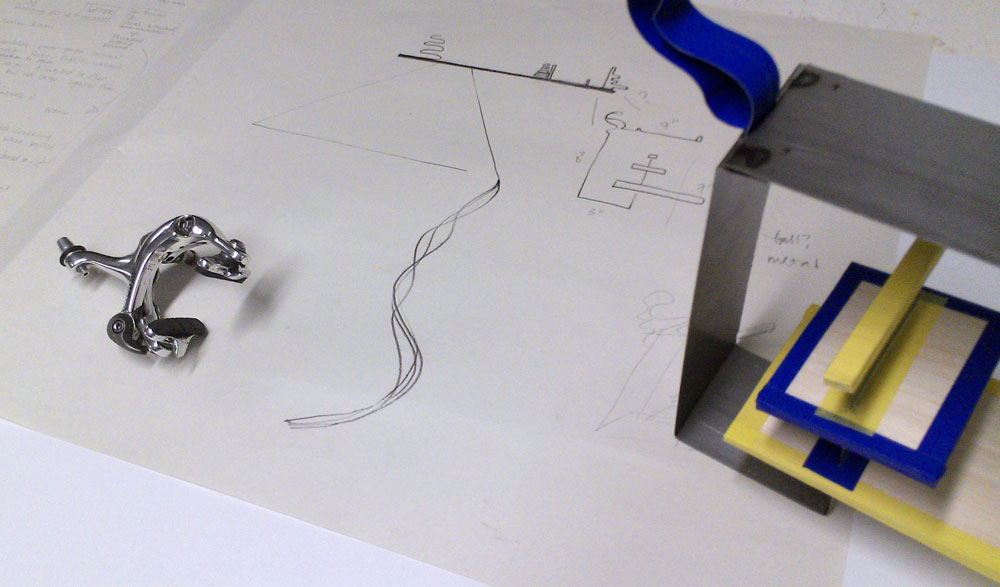
- the bike part; the drawing created from the description of the bike part; the object created by looking at the drawing
-
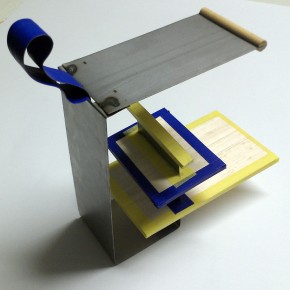
- Object created from drawing

As we grow up we get more and more efficient at putting things into categories, and creating a kind of short-hand for our experiences of things. Whilst useful in some instances, it can also work against us, limiting how much we really pay attention to things. Generalisations are made, things are lumped together or comparisons made to find the nearest ‘known’.
In some respects I found this exercise quite similar to experiences of mediation / mindfulness, or a good route for getting into the ‘flow’, and something I’ll definitely incorporate into my way of working as a good limbering up technique.