Making time tangible at the Institute of Creative and Cultural Entrepreneurship, Goldsmiths
Trust, tea, talent
Roxanne1Roxanne Persaud, Lecturer, MA Social Entrepreneurship—Institute for Creative and Cultural Entrepreneurship, Goldsmiths, University of London recently asked me to take part as creative director/artist in residence in a FUNconference with MA students in the Institute of Creative and Cultural Entrepreneurship (ICCE) at Goldsmiths. I had a broad awareness of the unconference2What is an unconference? https://en.wikipedia.org/wiki/Unconference format, and have worked with Roxanne, “professionally-informally”, for a long time now, and I trust her judgement. If she thought I could make a valuable contribution, albeit one that would reveal itself in the doing, then I was in!
The ‘becoming by doing’ process is one I’m familiar with; a lot of my art projects have revealed themselves in this way, and design sprints by their nature, iterate and develop as they go. I’m also curious about the nature of ‘work’; in its definition, and its regard depending on the context it is performed in.
Part of the remit of the day was to share stories amongst the students, alumni and tutors about how academic, art and work practices overlap and inform each other. The students attending were mostly in their last throes of dissertation writing for their MAs finishing this year, the alumni had gone on to work in various entrepreneurial roles, and I balance making durational and/or site specific artwork, with being a digital designer.
With trust, tea and talent in the room, it was going to be an interesting day.
Sustainable and collaborative visual identity
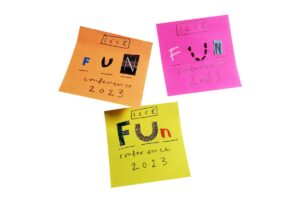
‘Scratch’ logos for ICCE’s FUNConference made on Post It notes using collage, crayon and even embroidering the letters
I was to design the visual identity for the event; with the brief being that it was sustainable, and with varying degrees of flexibility so that if people wanted, everyone could get involved in using and modifying it.
The first iteration was done quickly as a ‘scratch’ idea, using the workshopping staple, Post-It notes, and this was used to promote the event.
The final version was printed onto canvas in two versions. If people wanted to use the colour patches as-is, they just needed to fill in the date—the second half of the date was left blank for subsequent events, ensuring the visual identity will be valid until the end of the century!
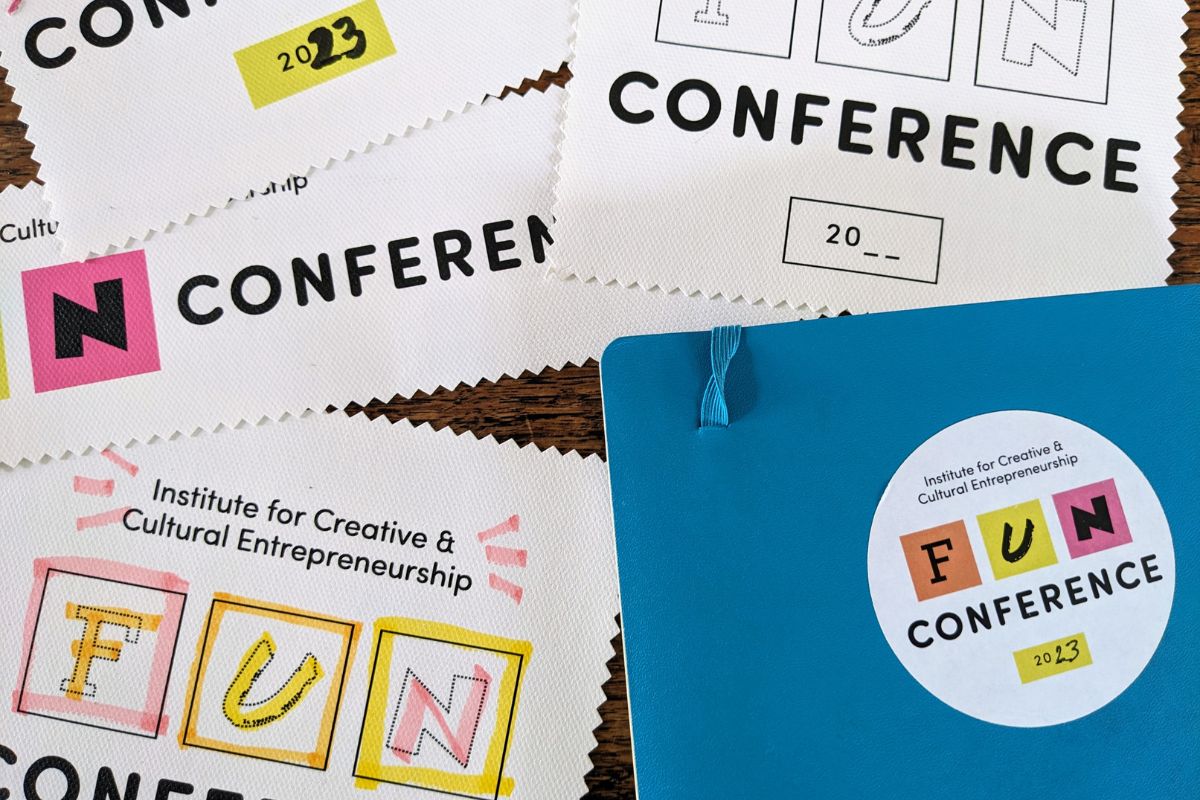
Image of visual identity for ICCE’s FUNConference applied to DIY patches, stickers etc
If people wanted to get creative, materials were provided to colour in, stitch, pin and stick their patches onto existing conference or promotional totes that were knocking about around the college; upcycling and building on what already exists without generating more ‘stuff’
-
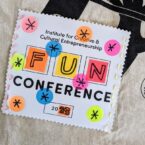
- A ‘colouring in’ version of the patch that has been modified with stickers and marker pens and sewn onto a Goldsmiths’ Student Union tote bag
-
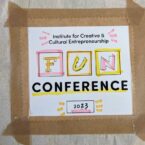
- A ‘colouring in’ version of the patch that has been modified with highlighter pens and attached to a tote bag with paper tape
-
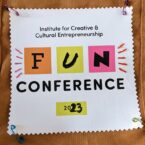
- A colour printed patch attached with safety pins to a tote bag. The date has been filled in to 2023
-
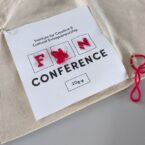
- A ‘colouring in’ version of the patch that a student embroidered onto and attached onto a bag with paper clips
-
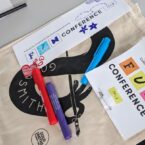
- Two versions of the patch that a student has coloured in and attached onto a Goldsmiths’ tote bag with safety pins
-
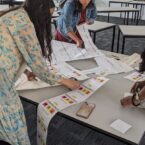
- Students getting involved in preparations for the day; the logos were printed as a single sheet onto canvas, and then cut into individual patches
FUNConference day
It wasn’t a pure unconference format—hence the play on the name—in that some of the agenda topics were shared anonymously beforehand in a Google form, which we then built on in the session. However the planning amongst Carla3Dr. Carla Figueira, Director MA Cultural Policy, Relations and Diplomacy. Director MA Tourism and Cultural Policy—Institute for Creative and Cultural Entrepreneurship, Goldsmiths, University of London, me, Nuria4Nuria Cortes Romero, Associate Lecturer—Institute for Creative and Cultural Entrepreneurship, Goldsmiths, University of London and Roxanne, was. We collaborated on a single Google doc that developed over time as we decided the structure of the day, what needed to get organised and done, and any other reference material added.
It turns out one of the topics that came up for the agenda was wondering how to make academic and theoretical knowledge tangible in the real world, which tied in fortuitously with the POMpomPOM workshop I would be running with the students later on.
We then divided into groups using the rule of two feet (ie, if you’re not interested and aren’t contributing, move to another group where you are, and can). Giving yourself, and owning permission was one of the themes that came up; along with:
- Informal doesn’t mean unprofessional
- A useful way to frame ‘disruptions’ (in entrepreneur speak) can be working out just how a small a nudge can you do to move towards the direction you want to see improvement in
- Setting up a non-fiction book group as a way of continuing interesting discussions for professional development
- Although different people in the room may all be there to learn, they are not all learning the same thing (be aware of your different contexts / power)
- “If I’ve mentioned interest in doing something more than twice and have yet to take a concrete step to make it happen, call me out!”
Using the Pomodoro technique to make pompoms
Or how to make time into a tangible object. Both Roxanne and I would self-describe as nerd-adjacent in our various approaches to Getting Work Done, and we both use the Pomodoro technique of breaking up a big thing into smaller things albeit in different ways in our own informal-professional sessions. Most recently, Roxanne has been using it for writing her PHD, and I have been using it to ensure I get up from sitting at my desk and moving about post back injury.
As a nod to my knitting data every day during 2021 in the form of a graph / scarf project, I wondered if in the FUNConference we could use a shorter unit of time, the Pomodoro timer’s classic 25 minutes, a way to co-create with the students and make tangible artefacts from the abstract concept of clock-time.
-
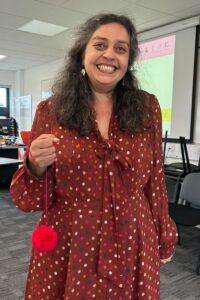
- Students, lecturers and alumni making pomPOMpoms; physical artefacts of a period of time
-
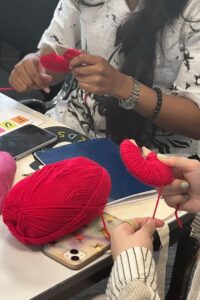
- Students, lecturers and alumni making pomPOMpoms; physical artefacts of a period of time
-
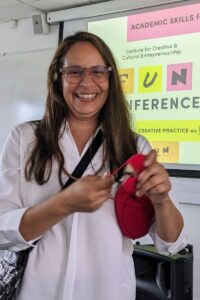
- Students, lecturers and alumni making pomPOMpoms; physical artefacts of a period of time
-
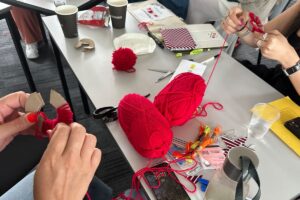
- Students, lecturers and alumni making pomPOMpoms; physical artefacts of a period of time
-
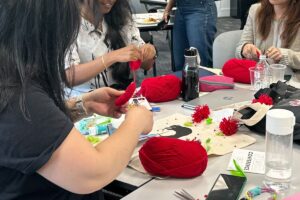
- Students, lecturers and alumni making pomPOMpoms; physical artefacts of a period of time
It worked! More people than expected got on board and, as with the other informal activities, the anonymous feedback from the students was positive; it seemed that it was a great way to change gears and re-approach their academic work.
“I found the pomodoro pom poms to be quite grounding”
“having a day together in a fun and informal way [..] helped me “reset” so to speak! Which was what I needed to get back into my dissertation”
Documentation in the open; next steps
The day was documented both in real time, and added to post-event, using Padlet. I’d never used this before and found it a great way for people to contribute in the round, ensuring insights across disciplines (the MA students were from multiple courses) and resources could be shared; break those professional silos! Will definitely use this again at collaborative workshops.
-
- Screengrab of the Padlet board we used to document thoughts; share resources etc
-
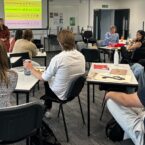
- Participants at ICCE’s FUNConference
-
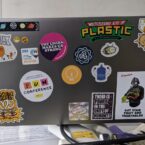
- Roxanne’s laptop with the FUNConference sticker on it :)
Roxanne and Carla collected feedback from the day and are using this to present a paper at this year’s ENCATC Congress – Education and Research Session. These insights will inform subsequent events run in the department, maybe across the college in general. Allowing space and time (with interrogative prompts and challenges) for this alternative way of sharing, exploring and applying knowledge felt valuable; it would be interesting to explore further iterations and see what happens next.
Photos: Emerald Mosley / Carla Figueira